100 proof. Pure Missouri Roots. Aged four years in charred Missouri white oak barrels, its proceeds support the nature that shaped it.
For this perfect-for-sipping bourbon to make its way into your glass, an acorn had to sprout into a strong Missouri white oak tree. The forest it called home had to be protected and nurtured. Eventually, the timber harvested turned into charred white oak casks, imparting incomparable natural flavors to the bourbon as it aged. It only feels right that proceeds from this bourbon will be reinvested into conserving the environments that shaped its journey. Pick up a bottle today at Fernweh Distilling Co. in Hermann, Missouri, or contact mchf@mochf.org to learn more.

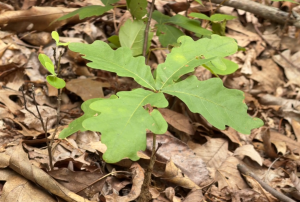 All Missouri white oaks begin their lives as acorns. Some end their lives transformed into something new: a bourbon barrel. The charred Missouri white oak gives bourbon 70% of its flavor, infusing it with the spirit of Missouri woodlands. “So should it really be ‘grain to glass,’ or should it be ‘acorn to glass?’” Jason Green, the LAD Foundation’s Director of Land Stewardship, said. “You can’t have your bourbon, and really your whiskey, without the barrel.” To honor this journey, we decided to create Acorn to Glass, Missouri’s first-ever conservation bourbon. This is its story.

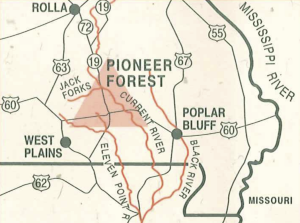 Welcome to the Pioneer Forest, 62,000 acres of woodlands spread over six different counties near the Current River in southeastern Missouri. In the 1950s, Leo Drey purchased this land and began restoring it, eventually donating it to the L-A-D Foundation. Today, the L-A-D Foundation receives most of its funding through timber harvest, which they do in a way that preserves the forest for future generations. “What we’re talking about is uneven-age forest management – that’s been the heart and soul of Pioneer Forest,” Jason said. “If it’s all done right, and we make sure that it is, the forest is still very much intact. In a nutshell, we’re cutting the worst and leaving the best. It creates a hole in the canopy. Light from the sun then reaches that forest floor, and that’s where your new trees come in.” After an area of the forest is harvested using this method, it’s left alone for 20 years to do what nature does.
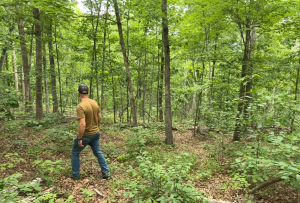
As the L-A-D Foundation moves through the forest, harvesting different areas and keeping the forest healthy, they’re creating many different types of habitats and thus expanding the forest’s biodiversity. “It provides this patchwork, this quiltwork, of different habitat types for different species,” Jason said. “I think a lot about birds. If you have an older stand and you harvest it, those species may not prefer that area anymore. So they’ll move to a different area [in the forest] to find the habitat needs. When you’ve done that, you’ve also created habitat that some other species is going to prefer, so they’re going to be moving in and utilizing that instead.”

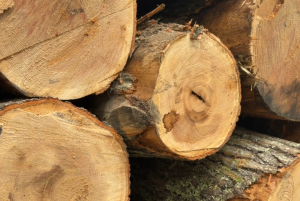 Every year, Missouri harvests between 600 and 800 million board feet of timber, contributing to a $10 billion forest products industry in our state. Missouri white oaks make up more than a quarter of that.
Jason’s team of foresters are deep in the forest every day, marking which trees to harvest and which to leave to grow. Local logging teams, many of which are generational family businesses, then come in and take down the marked trees. The loggers are extremely careful not to damage the forest left behind – an impressive feat given the heavy machinery needed to get the job done. “Even though you do have timber harvest … the forest is still the forest,” Jason said.
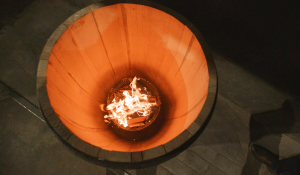 After the white oaks are harvested, they’re sent to be cut into staves, charred, and formed into barrels to be used by distillers. Fun fact: Missouri white oaks are prized as bourbon barrels because they’re completely leakproof! This is due to a cellular phenomenon called tyloses, which allows the wood grain to keep liquid from passing through. White oak barrels don’t use any adhesive to stay formed in that barrel shape – the tyloses in the wood keeps them stuck together naturally!

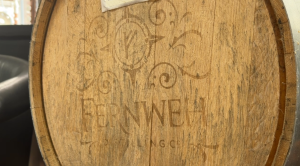 The local craft distillery behind Acorn to Glass is Fernweh Distilling Co. in Hermann, Missouri. According to Fernweh Operations Director Andrew Weiss, they love using white oak barrels for their heartiness and wealth of flavors. Once the barrels are assembled and charred, they’re ready to hold bourbon. “The char is going to act as your carbon filtration, not only for flavor, but it’s going to take out all of those unwanted flavors too,” Andrew said. “Then we want all of our barrels to be around the elements, so those barrels can breathe. We really like the frigid cold that we get here in Missouri because it’s going to push all that whiskey out, and then the hot, hot 100 degrees is going to absorb a lot of that whiskey. We let nature take hold, and that Missouri white oak just creates that product for us.”

 At the final stage of its evolution, Acorn to Glass combines aromas of clove and sweet tobacco with flavors of caramel, coffee and walnut. When you take a sip, we hope Missouri’s towering white oaks come to mind. In indulging in a bottle of Missouri’s first-ever conservation bourbon, you’re actively protecting the trees, forests and wildlife that shaped it – from acorn to glass.
Thank you to our partners!